
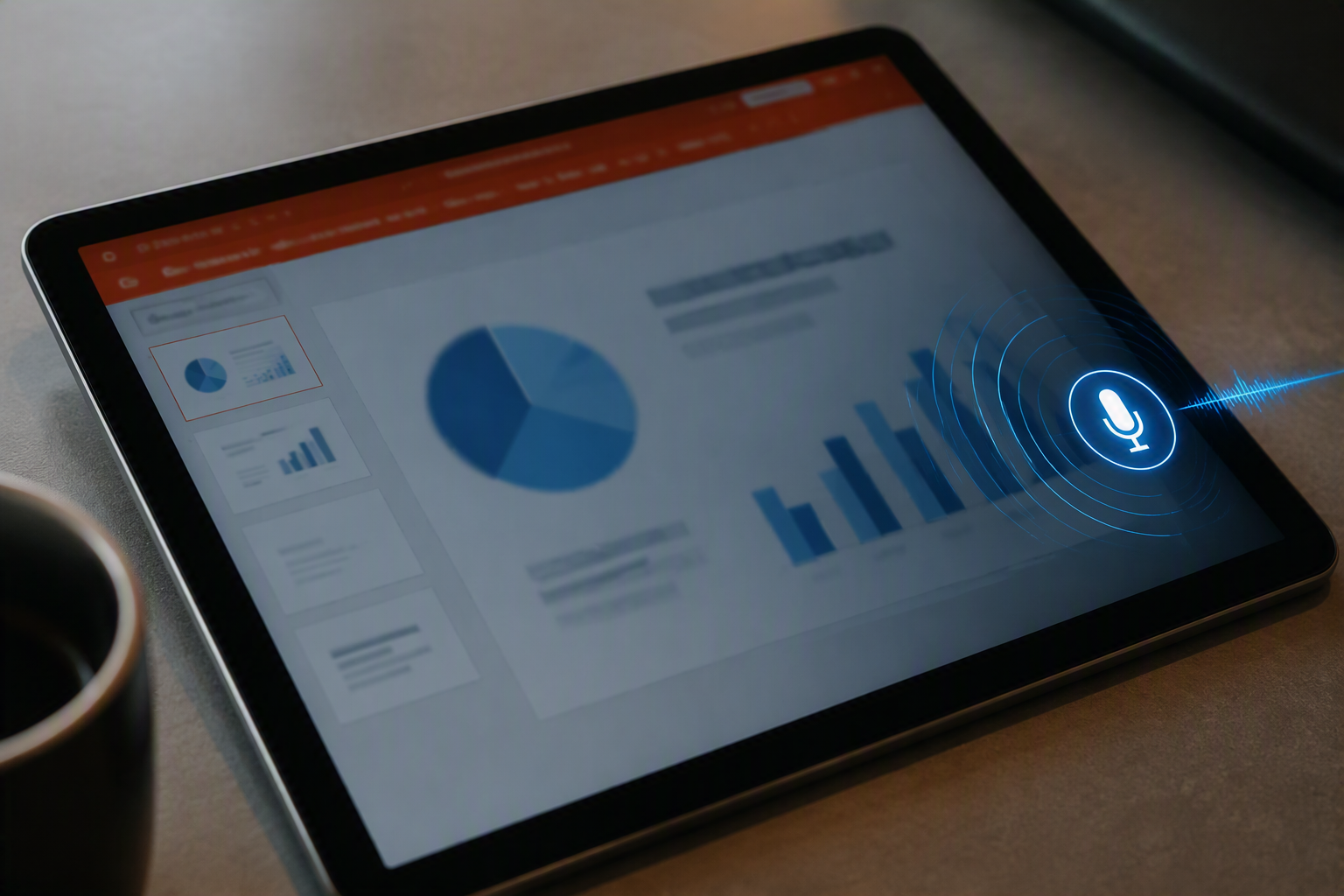
Copilot is getting a voice in Word and PowerPoint: realtime voice interactions from October 2026
Microsoft is bringing back a Microsoft 365 roadmap feature that lets you talk with Copilot in Word and PowerPoint: instead of typing a prompt, you speak to the assistant out loud and get realtime answers about the content of your document or presentation. Rollout is planned for October 2026 — the second attempt at release after a pause for rework.
What was actually announced
The feature is called realtime voice interactions and covers two apps — Word and PowerPoint. The idea is simple: instead of typing a text prompt, you talk to Copilot, and it responds in real time about the content of the document or presentation you currently have open. In practice, this brings the same conversational-interface approach Microsoft already tested in Copilot's voice mode on mobile and in Copilot Voice for general queries into the desktop Office apps — only now tied to the specific file you're working in.
Microsoft's own wording — "talk with Copilot, interact in real-time, and understand the content within your document or presentation" — points to two distinct scenarios: dialogue (asking a question or giving a voice command) and content understanding (Copilot analyzes the actual document or slides open right now, rather than answering from general knowledge).
Why this is already the second launch date
The September 9, 2026 roadmap update is worded carefully: "we will be re-releasing this feature with updates in October. Thank you for your patience." This is Microsoft's typical phrasing for features that already shipped in a limited form or in testing, after which the product team found issues — most commonly speech-recognition quality, realtime response latency, or behavior in multilingual environments — and pulled the release back for rework.
For companies, that's a practical signal, not a footnote: if a feature has already missed one announced date, it's worth budgeting extra time around the October release too. The Microsoft 365 roadmap regularly shifts dates even for features marked "In Development" — the same kind of staged rollout also showed up with Copilot in Power BI for executives, where new capabilities arrived in waves rather than a single release.
Where this actually helps in day-to-day work
Editing on the go
Dictate edits to a document by voice while your hands are busy with something else — useful for managers drafting a report between meetings.
Rehearsing a presentation
Ask Copilot out loud whether the slide structure makes sense, and get an answer without breaking your flow to type it out.
Quick document catch-up
Ask for a spoken summary of a long report or contract before a meeting, instead of reading through the whole text yourself.
Accessibility
A voice interface lowers the barrier for employees who find keyboard-and-mouse interaction uncomfortable or difficult.
What companies already using Copilot should keep in mind
Voice interaction with a document means a new data channel appears in Microsoft 365 — a recording of the user's voice and, likely, a temporary transcription of the speech on the service side to process the request. That's a natural extension of the same principle we covered in depth in Copilot security and confidential company data: voice is processed within the same access rights and Data Protection Agreement boundaries as text prompts, but security teams should ask Microsoft in advance whether anything changes in data-retention policy specifically for voice data once the feature exits its test status.
The second practical point is licensing. The feature is tied to Copilot in Word and PowerPoint, meaning it's available to users with an active Microsoft 365 Copilot license. Companies still weighing whether their team needs Copilot at all, rather than just external AI chats like ChatGPT, may find Microsoft Copilot vs ChatGPT: what's the difference for business useful — voice mode doesn't change that underlying difference, it just adds one more way to interact with the same company data.
Our recommendation for October 2026
Companies that already hold Microsoft 365 Copilot licenses should wait for the October rollout, test the feature with a small group of users, and only then decide whether to fold voice mode into standard document workflows. For teams that haven't adopted Copilot yet, this feature isn't a reason to rush a decision — it's one more argument that the Microsoft 365 AI ecosystem is moving faster than standalone AI tools without integration into a company's working files.
Frequently asked questions
Is realtime voice interaction with Copilot in Word and PowerPoint available yet?
No, as of September 2026 the feature is marked "In Development" on the Microsoft 365 roadmap, with rollout planned for October 2026. This is already the second announced date after an earlier pause for rework.
Does the Copilot voice mode require a separate license?
No separate license is required — it's added to Copilot in Word and PowerPoint for users who already hold an active Microsoft 365 Copilot license.
How is Copilot's voice mode different from the dictation feature already in Office?
Standard dictation converts speech to text without understanding the content. Voice interaction with Copilot is a dialogue: the assistant analyzes the content of the open document or presentation and answers the actual request, rather than just transcribing what was said.
Assessing whether your company is ready for Copilot in Word, Excel, and PowerPoint?
Progresia runs a readiness audit and helps roll out Microsoft 365 Copilot so your team actually uses the new features instead of leaving the license unused.