
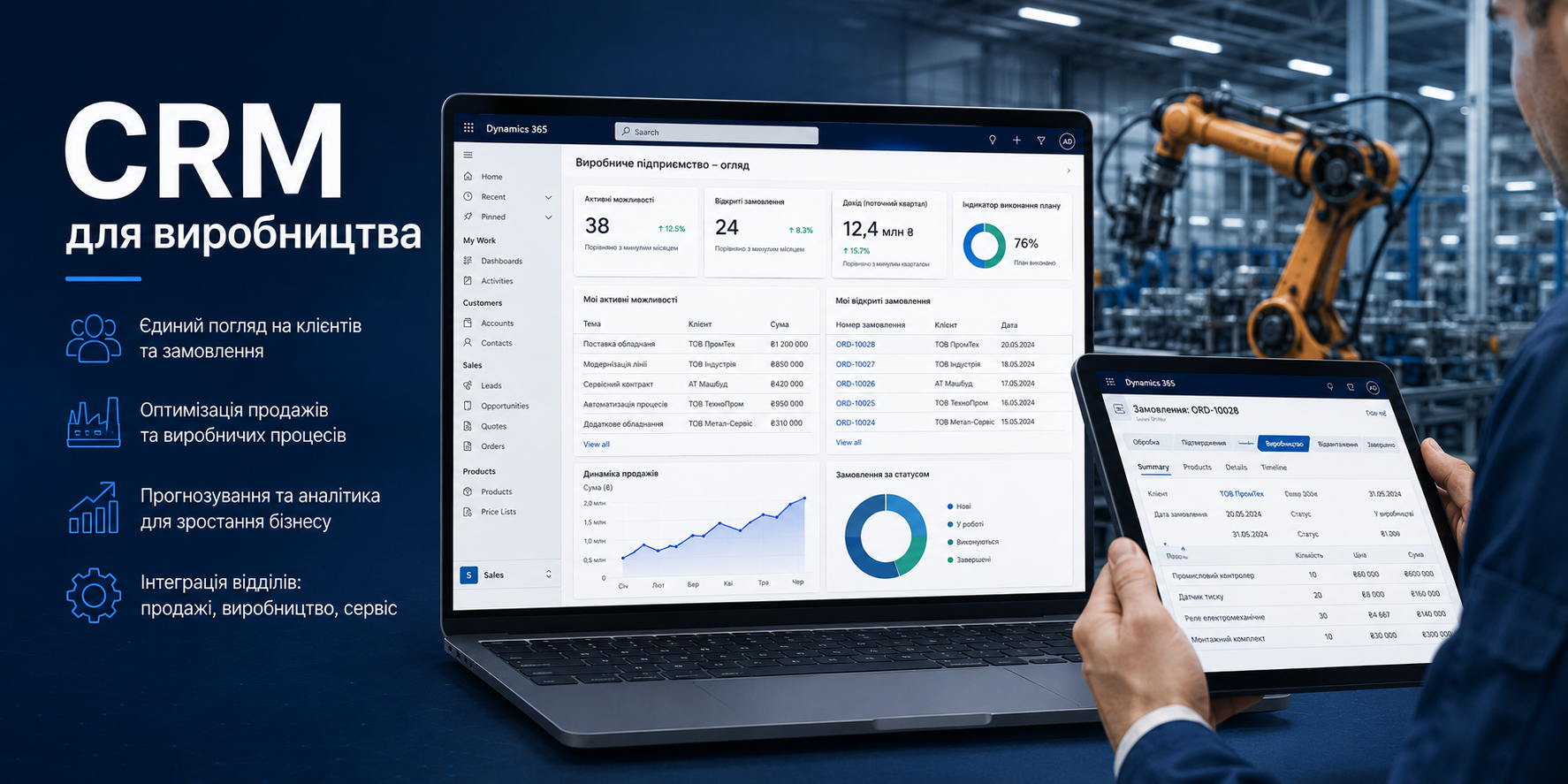
CRM for Manufacturing: How Dynamics 365 Connects Sales, Production and Service
Why manufacturing companies lose orders due to the disconnect between sales and the production floor — and how Microsoft Dynamics 365 closes the loop from the first inquiry to shipment and after-sales service.
Where a standard CRM falls short for manufacturers
Manufacturing is a unique vertical for CRM. There is no simple "pick from shelf and ship." Every order may carry a custom specification, a lengthy approval cycle, and a dependency on production capacity and supply chain availability. Generic CRM tools built for retail or services simply do not cover these needs.
Typical pain points for manufacturers without a CRM:
- Specifications are passed from sales to engineering by email or verbally — then lost or misinterpreted
- Order status is invisible in real time — clients call repeatedly just to get an update
- Preparing a quote takes 2–5 days because product configuration is done manually
- Sales reps have no visibility into production capacity before signing a contract
- After-sales service and warranty tracking exist in a completely separate silo
- Revenue forecasting is impossible when the sales pipeline and production schedule are disconnected
What Dynamics 365 delivers for manufacturers
Microsoft Dynamics 365 for manufacturing is more than a CRM. It is a unified platform connecting your commercial team, engineers, production planning and service operations in a single information environment.
Product Configurator (CPQ)
Sales reps configure the product directly in CRM — material, dimensions, options. The system automatically calculates pricing and generates a production specification.
Complex Order Management
Every order is a tracked record with statuses, deadlines, owners and attached documents. All stakeholders see real-time updates — no status meetings needed.
Production Plan Sync
A confirmed order flows automatically into the ERP production schedule. Sales reps can check real capacity availability before committing to a delivery date.
Pipeline & Forecasting
Management sees the pipeline in revenue terms with probability-weighted forecasts. Power BI dashboards enable production volume planning months in advance.
Service & Warranty Management
After shipment, the client stays in the same system. Service calls, warranty claims and field engineer dispatches are all managed within one customer profile.
Supplier & Procurement Visibility
Supplier lead times and material prices sync with the ERP procurement module. Sales and operations know about supply risks before they become delivery failures.
Long sales cycles: how to keep a 9-month deal from slipping away
In manufacturing, the sales cycle is rarely short. A B2B order from tender inquiry to signed contract can take 3–12 months. During that time, material costs shift, production capacity changes and contact persons turn over. Without a CRM, deals get lost along the way.
Here is what that cycle looks like with Dynamics 365:
Lead capture & qualification
Leads from your website or trade show are captured in CRM automatically. The rep qualifies the need, attaches the client's RFQ, and estimates deal value. Copilot in Dynamics 365 suggests the next best action based on similar won deals.
Quote preparation
The product configurator builds the specification inside CRM. Pricing is calculated automatically against current material costs. A formatted quote is generated from a template in 15 minutes instead of 3 days.
Technical review & approval
The specification is sent to engineers directly from CRM — with a task and deadline. Engineers confirm feasibility or return with comments. All communication is logged in the system. No more "I thought you said…"
Contract signing & production launch
When the contract is signed, the order automatically transfers to the ERP production module with all parameters intact. Production receives a complete, accurate record — not a transcribed note.
Execution tracking & shipment
The sales rep monitors production status in real time. Clients receive automated notifications when the order is ready and shipped. Documents are generated in ERP and signed electronically.
CRM + ERP integration: one source of truth for sales and operations
The key advantage of Microsoft Dynamics 365 over standalone CRM tools is its native integration with Dynamics 365 Business Central (ERP). For a manufacturer, this means:
- Sales reps see real production capacity — before signing the contract, not after
- Specifications flow from CRM to the production schedule without re-entry — eliminating transcription errors
- Raw material purchasing triggers automatically when an order is confirmed — reducing lead times
- Order cost is calculated in real time based on current material prices and machine utilization
- The CFO sees projected revenue and margin per order in a single dashboard
For engineer-to-order and make-to-order manufacturers
If every order is unique — custom furniture, steel structures, industrial equipment, print production — off-the-shelf CRM tools are not designed for your workflow. Progresia has hands-on experience implementing CRM + ERP for exactly this type of manufacturing: with a product configurator, order project management and a full service loop.
After-sales service: the relationship doesn't end at shipment
For equipment and product manufacturers, the sale is the start of a long-term relationship — maintenance contracts, warranty repairs, spare parts supply, upgrades. Dynamics 365 Field Service automates this entire loop:
- Every installed unit at a client site has its own record: serial number, installation date, warranty terms and full service history
- When a client calls, the dispatcher sees the full context — what was installed, when, what has already been repaired
- Scheduled maintenance is assigned automatically — no manual calendar reminders
- Field engineers receive job assignments on their phone with site details, equipment specs and required parts
- Telephony integration logs every client call to the account record — whoever picks up already knows the context
The result: clients never have to explain their situation from scratch. Service becomes a competitive advantage, not a source of complaints.
Analytics for manufacturing leadership
A CEO or Sales Director needs answers to specific questions: how many deals are in the pipeline, for what value, with what probability of closing, and where are the delivery risk signals? Power BI embedded in Dynamics 365 delivers those answers — without morning status calls or manual report collection:
- Revenue pipeline with probability-weighted monthly and quarterly forecast
- Production capacity by month — where capacity windows exist, where overloading is a risk
- ABC client analysis: who drives 80% of revenue, which A-clients haven't ordered recently
- Margin by product category and by individual order
- Average deal cycle time and where it stalls — for more accurate planning
Implementation timeline for a manufacturing company
Phase 1 — Process audit (1–2 weeks)
We map your current order-to-shipment cycle: where handoffs break down between departments, where data gets lost, where the biggest time and revenue leaks are. Requirements are captured in a technical specification signed by both parties.
Phase 2 — Configuration & integration (3–5 weeks)
We deploy Dynamics 365 Sales and Business Central, configured for manufacturing: product configurator, production plan integration, approval workflows, service module. We connect your existing systems — 1C, telephony, EDI — where applicable.
Phase 3 — Training & pilot launch (1–2 weeks)
We train sales reps, engineers and management. We run the system on live orders in parallel mode. Adjustments are made based on the first weeks of real use.
Phase 4 — Full rollout & ongoing support
The full team transitions to the new system. We provide 24/7 technical support and regular updates. Most clients return within 3–6 months to expand: adding Power BI analytics, marketing automation, field service or a client self-service portal.
Why Progresia, not just any Microsoft partner
Dozens of partners sell Dynamics 365. The difference is industry depth. Progresia brings:
- 10+ CRM and ERP implementations for manufacturers — metalworking, food production, furniture, industrial equipment, print
- Ready-made product configurator templates for engineer-to-order and make-to-order environments
- A team of 50+ certified Microsoft specialists, including Dynamics 365 solution architects
- Own products: Progresia.Chat — omnichannel communication via Telegram, Viber, WhatsApp + Microsoft Teams
- 24/7 support with a 4-hour SLA on critical incidents
A CRM implementation for a manufacturer is a strategic engagement, not a one-off project. We design the system with your 2–3 year growth trajectory in mind.
Get a free sales process audit
We'll show you exactly where time and money are lost in your order-to-shipment chain — and how Dynamics 365 fixes it. No templates, no generic pitch.